

Is AI Going to 'Take All the Jobs?' The Wizard Says: 'Maybe Not!'
July 16, 2026 · Jeffrey C. Dunnihoo
You’ve heard that AI will take all the jobs. Even artists and writers? Not in this case!
From pencil sketches to funny AI fails and hours of old-fashioned digital painting, making The Wonderful Wizard of Electronics proved that AI is a powerful sidekick, but not the main character. That still comes from stubborn human creativity.
In March of 2025, a colleague in the education field was talking about new STEM curriculum projects, and mentioned that there was a need for something that connected concepts of circuit-level switching and the digital logic of computers in a very child-friendly way.
The Circuit Theme: Individual components, like people, function best when they become part of something larger than themselves.
The Spark
As an electrostatic discharge EMC engineer, and having recently designed various electrostatic detection circuits for customers, the idea formed instantly. We could use the detector circuit in its most basic form, a Junction-FET transistor with a floating gate to sense electric fields and turn on and off an LED.
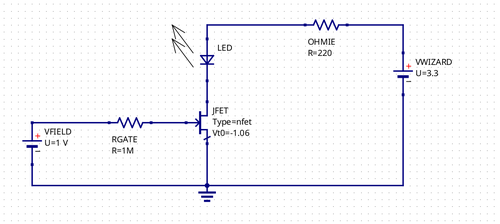
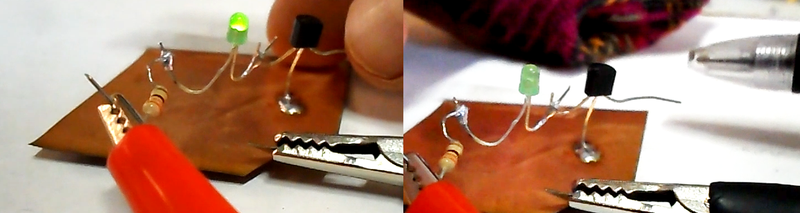
I cobbled up a circuit demo, and the "friends holding hands" immediately formed the working title "The Wonderful World of Ons and Offs." Perhaps I should say it was an "unworkable" title.
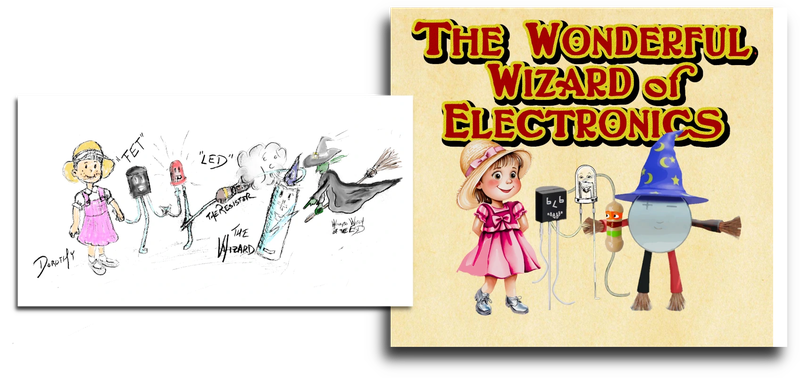
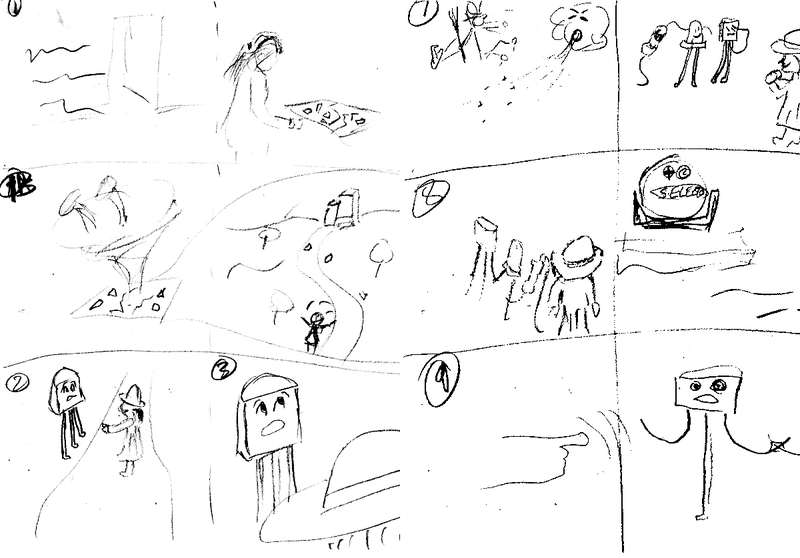
That afternoon I sat down with a scratch pad and sketched out the whole thing in under an hour. Title page, main characters, the basic storyboards. Nothing fancy. Just layout and story flow. Just enough to see if the Wizard of Oz parallel would actually work with transistors and resistors instead of scarecrows and tin men. It did. The parallels clicked instantly and the character names yelled themselves out of the pages. "Ellie Dee" I crack myself up. =D
Here’s the original title-page sketch next to the finished published page. When considering the circuit board costs later, The Wizard morphed from a cylindrical "AA" battery to a CR2032 computer memory battery that could "sit" in a vertical throne (battery holder.)
Rough Storyboard Scans
These black-and-white scans are the actual first frantic minutes, super loose outlines, barely more than stick figures with labels. This is the picture book version of a novelist's S.F.D. (Let's call it, "Silly First Draft," shall we?
And Then The Terror
How are we going to get this illustrated with the budget of ZERO dollars and a bucket of tears?
At the time, one and a half years ago at this writing, AI proponents were evangelizing the "end of Hollywood" and AI music and Stable Diffusion would spell the end of human generated art within mere weeks.
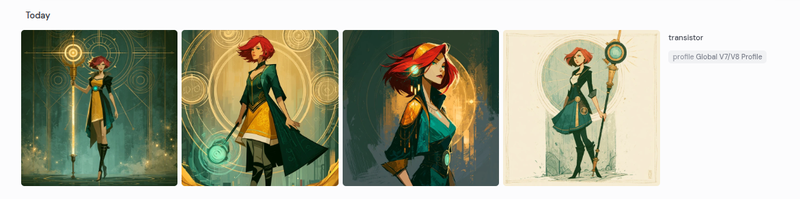
As I searched for the early tests just now, for contrast to test progress I typed “transistor” into Midjourney expecting, well, a transistor. Apparently the state of the art tokenizer is more likely to understand that single word as actually some particular kind of "sister." You be the judge.
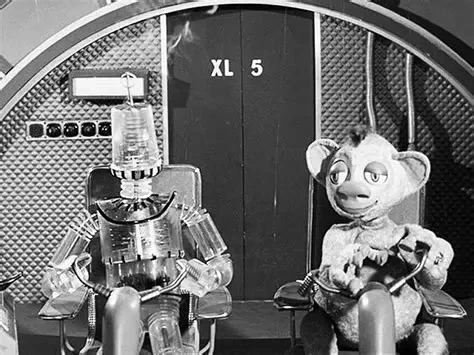
Anyhow, at the time, I worked on all permutations of text-to-image prompting with seed images of actual transistor packages and asked for anthropomorphic transistor and LED characters talking and gesticulating. Fair enough: the concept of anthropomorphic Cars and fish are well established, but the AI training datasets cannot have much depth on "talking and gesticulating" electronic components, because it hadn't been done before SOIC and SOT. The results looked nothing like real devices. They looked like confused 1960s robots that had wandered out of Fireball XL5 without their puppet strings.
For contrast, here’s a cold photo of a real TO-92 transistor sitting next to the hand-painted JFET that ended up in the book. One is a precise little three-legged component.
The other is Jay, our friendly JFET with personality.
The AI never got anywhere close.
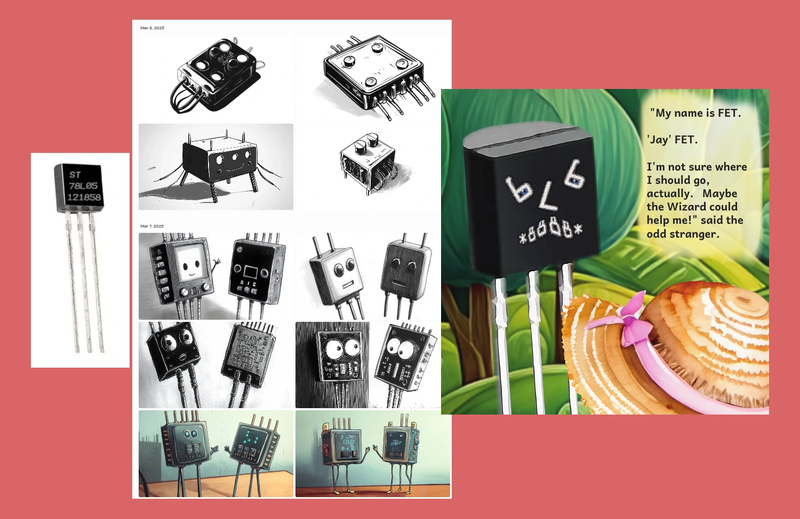
Fun Fact: JFET's eyes and nose spell "6L6" a famous audio amplifier tube used in present-day "vintage" guitar amps. His mouth is from a punch-card optical font from the 60's warped with Open Source Graphical Image Manipulation Program (GIMP). You can't spell JFET with AI!
The Process x 40+ pages
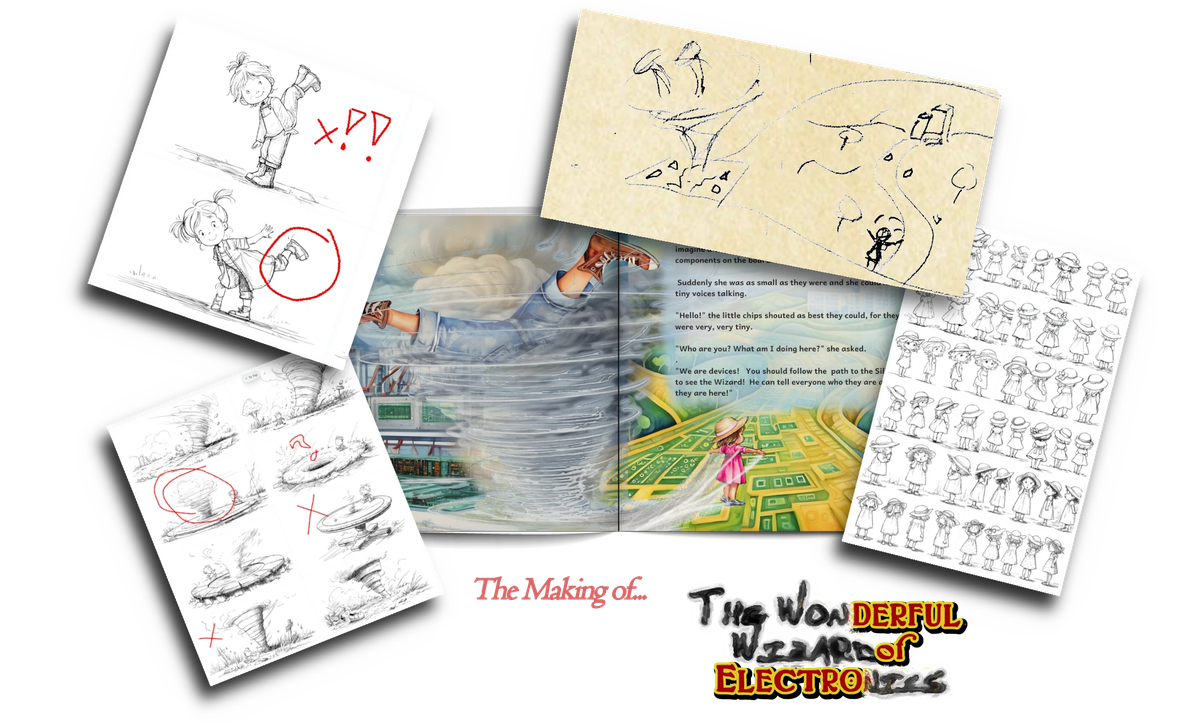
Below is an example of a two-page layout in Wizard showing the finished spread and all the pieces that went into it: original pencil sketch from the storyboard layout (top), AI character study attempts at Dorothy being sucked into the whirlwind, manual ink work, color tests, and the final composite. You add shading, shadows and correct lighting angles. You manually paint in the wind and test for contrasts for visually impaired access. (Don't forget everything that goes into rewriting, editing and layout of the text elements.)
On their own, you may prompt a hit here and there with exactly what you're looking for. But if you try to combine too much into a prompted element, like a "whirlwind on a table top," the AI training will provide fewer matches to what you're imagining. That is to say, what you're thinking may be too creative for it to follow.
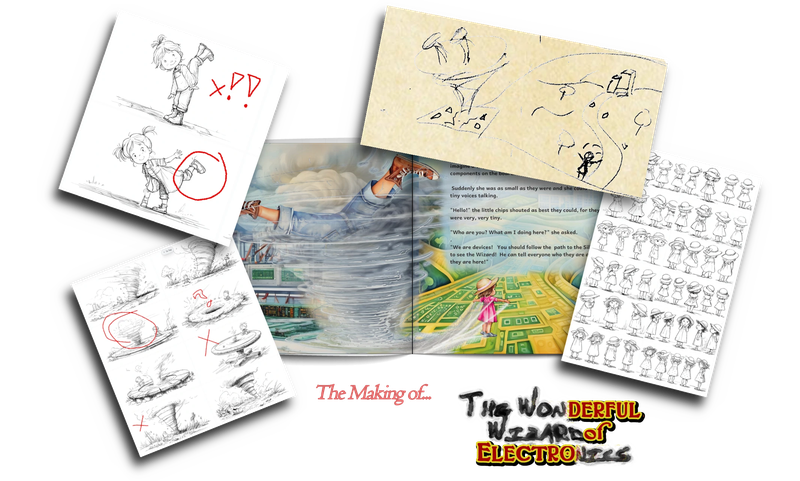
When you select, tweak, edit and combine the elements yourself, you become the executive art director matching the style and direction in your head, and not the training of the AI.
What I Learned After Hundreds of Painful Hours
From my limited (but expensive) experience, AI can be fantastic at one particular job when you already have some basic artistic skill. It helps you crank out character variations and options fast so you can see what works early and steer the whole project. It can be an advanced time-saver for repetitive coloring and inking once you draw exactly what you want.
But when the concept is too weird (like anthropomorphized transistors with personality,) the AI just spins its wheels and gives you pretty nonsense. At that point you’re back to pencil, paper and digital canvas.
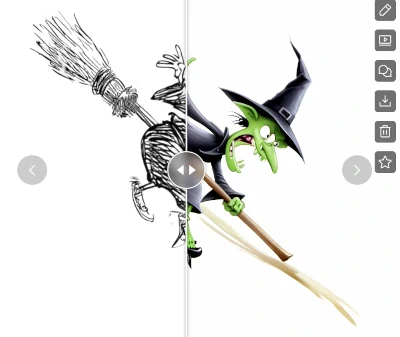
What AI can be very good at, though, is for "inking" a well-defined sketch, as with the witch inked in OpenArt.ai below. You still have to fix shading, eyeballs, stray broom whisks, and of course, fingers. But by setting the diffusion model's temperature to zero (or "creativity" to "None") you essentially get a very advanced photoshop filter that can save you days and weeks of digital painting.
The Recent USPTO and Court Rulings on Creativity
This part actually got interesting while we were finishing the book. The U.S. Copyright Office and courts have drawn a pretty clear line: pure AI output with no meaningful human input doesn’t get copyright protection. Only natural persons can be authors.
The D.C. Circuit put it plainly in Thaler v. Perlmutter (March 2025, and the Supreme Court declined to review it in 2026): “The current Copyright Act’s text, taken as a whole, is best read as making humanity a necessary condition for authorship.” They pointed out that the law talks about an author’s life span, widow, children, signature, and intentions, none of which make sense for a machine. AI is treated as a tool, like a camera or a paintbrush or photoshop, not the creator.
On the patent side, the USPTO updated its guidance in late 2025. They reaffirmed that only humans can be inventors, and AI is “analogous to laboratory equipment, computer software, research databases, or any other tool that assists in the inventive process.” The key question stays the same: did the human make a significant contribution to the conception of the invention? If you sketch, compose, select, modify, and arrange the pieces, that human work can be protected. Prompts alone? Not enough.
You can read the USPTO’s Revised Inventorship Guidance for AI-Assisted Inventions (November 28, 2025) here: https://www.uspto.gov/subscription-center/2025/revised-inventorship-guidance-ai-assisted-inventions. The Copyright Office report on works incorporating AI-generated material (January 2025) says basically the same thing: human modification and arrangement can create protectable expression, even if parts came from AI.
That distinction seems obvious to me. It keeps AI as a powerful assistant instead of a replacement, which is exactly how we used it.
Give the Devil its Due
Some will protest, “Just wait 12 more versions and ChatXYZ will do everything!”
It’s true that AI development keeps churning. But research like David Cropley’s ("The “The Cat Sat on the ...?” Why Generative AI has Limited Creativity," 2025) shows that standalone AI output is mathematically capped at roughly amateur-to-early-professional level. Cropley exactly predicted my own experience about what happens when humans control the creative feedback loop, beyond mere prompting and hoping. But with curation, correction and composition humans can push results well beyond the AI ceiling. Studies show that well-guided human-AI teamwork often outperforms either humans or AI working alone.
The winners in this new world won’t be the ones who let AI take over, they’ll be the ones who master it as a powerful sidekick while bringing their own stubborn human creativity to the table.
Biggest Thank You of All
This whole adventure only deepened my respect for people who do it the old-fashioned way from scratch. Simona Ceccarelli brought the original SOIC and SOT characters to life with nothing but talent, training, patience, and a real understanding of how those little packages actually look on a board. She set the bar high, and I'll likely never reach it.
But yeah, I used some AI where it helped to get this underlying concept out of my head. But the heart of this book, the characters kids actually fall in love with, the story that makes electricity feel like magic without oversimplifying it to the point of lying about what it is, that part came from pencil, paper, real components on the workbench, and a whole lot of stubborn human creativity.
And that’s the message I hope sticks with the kids who read it.
Technology is an amazing tool. But there will always be a place for learning, teaching, creating, and inventing, as long as we treat the tools like tools and never try to replace the carpenter with a hammer.